
Since the early years following the establishment of the State of Israel, the relationship between Jews and Palestinians has been analyzed in terms of dynamics associated with colonialism, particularly with regard to the expansion of settlements and its implications, such as the displacement and expropriation of populations, demographic manipulation, practices of ethnic cleansing, and the imposition of military rule on the Palestinian population. The literature suggests that settler colonialism can, under certain conditions, escalate into extreme forms of violence, including genocide. Among the frequently cited examples of this type of colonialism are Australia, New Zealand, the U.S., Canada, Namibia, and South Africa.
The Israeli government’s political actions have been analyzed in conjunction with dynamics linked to colonial ambitions, with the attack of October 7, 2023, carried out by Hamas and other Palestinian armed groups, serving as a catalytic event. The recurrence of certain episodes creates an ambivalent perception, marked by a sense of strangeness and, at the same time, familiarity. This ambivalence tends to shift toward the recognition of a previously signaled tragic reality, one that can be interpreted within the framework of genocide understood as a process. From this perspective, the structural conditions framing the Israeli government’s actions were able to persist over time without, in an initial phase, necessarily being identified as constituting a genocidal dynamic.
Genocide can never be justified under any circumstances, including when invoked under the pretext of self-defense. As is evident in Gaza, lethal crimes have been committed against the Palestinian population without the perpetrators being held properly accountable. Under international law, there persists a culture of impunity, in which the commission of crimes or the violation of legal norms is not accompanied by effective mechanisms for accountability. This lack of accountability constitutes a widely documented enabling factor for extreme crimes, including, under certain conditions, genocide.
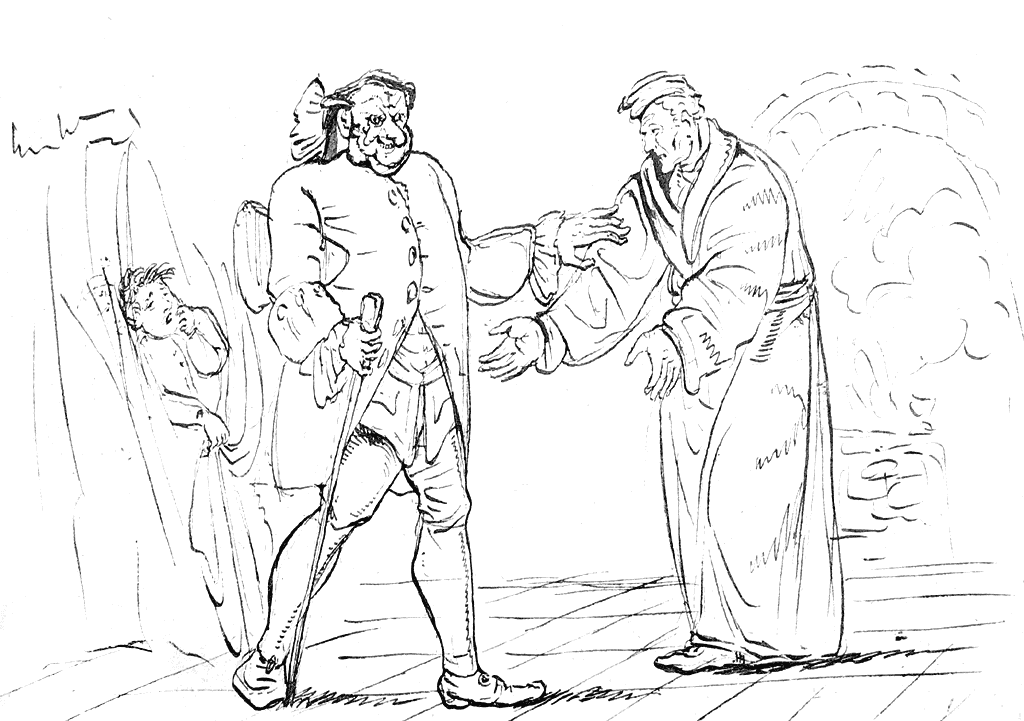
The sense of familiarity that comes from following the news seems to have deepened, since this is no longer a matter of isolated incidents, but rather the consolidation of a systematic pattern that suggests repetition and allows us to foresee its possible consequences. As in E. T. A. Hoffmann’s story The Sandman, it seems we are facing an inevitable evil that appears to throw sand in our eyes and blind us. The dehumanization of others, in the process of genocide, blinds us, and our actions seem predetermined.
Créditos na imagem de capa: E. T. A. Hoffmann